Showing posts with label adult teeth. Show all posts

Tuesday, 4 June 2013

A song of ice and teeth...

Around 5000 years ago, a middle-aged man died in a mountain pass located in what was to become the border between Austria and Italy. He was quickly buried by ice and remained there until he was discovered in 1991. Initially thought to be the remains of a deceased mountaineer, he soon became known as Europe's earliest natural mummy, christened 'Ötzi' by his discovers.

File:OetzitheIceman02.jpg
'ice to meet you. Ötzi the 'Ice Man' currently resides at the South Tyrol Museum of Archaeology, Italy
Although the remains of this remarkably well-preserved Neolithic man have been scanned, tested and analysed regularly since his discovery, it is only recently that his mouth has been systematically assessed.

University of Zurich researchers have looked at high resolution 3-D scans of the 'Ice Man' and the results suggest that problems with his dental health may have added to his already long list of ailments (poor Ötzi had broken ribs, arthritis, parasitic worms, gall bladder stones and had probably died having taken an arrow to the shoulder.)

Iceman Ötzi had bad teeth
CT scan of Otzi. Note how flat the tooth line is - a sure sign of dental wear.
Photo courtesy of the University of Zurich.

His teeth were extremely worn down, from a tough and gritty diet. Dental wear isn't something a lot of modern populations have to contend with - but Ötzi had lost about two-thirds of the height of most of his teeth. This wasn't the only thing wearing him down* though. His tough diet had also contributed to some tooth chipping, caused by small stones in his food, a 'dietary accident' according to the researchers.

Ötzi was found to have had at least two cavities, one of which was so extensive it had penetrated the nerve containing pulp cavity within the tooth. The team from Zurich also noted a great deal of change and loss to the bone around the tooth sockets, indicating a moderate to severe level of periodontal (gum) disease.

It is not unusual to find these kind of dental conditions in such an individual. Tooth-brushing isn't thought to have been happened much in Europe in the stone age and although Ötzi was found with numerous tools and equipment - a toothbrush was, unsurprisingly, not found amongst his belongings.


* Sorry. I couldn't resist.

For more information, see:
http://onlinelibrary.wiley.com/doi/10.1111/eos.12037/abstract;jsessionid=234243E97FE307DEA5A30EF7477683A8.d03t03

Wednesday, 5 December 2012

Kissing a donkey and spitting on a frog!

In the throes of agonising toothache, could you imagine kissing the teeth of a living donkey in an attempt to cure yourself? If you can't, that's understandable - but it's exactly what you would have done in the 14th century... and much more besides.

The cures for toothache in the past are difficult to believe and some of them are difficult to stomach. From spitting into the mouth of frog in the hope it would take on your pain for itself to sucking on the freshly extracted tooth of a dead man, past populations would try anything to alleviate the pain of cavities and gum disease.

Until the germ theory of disease was discovered in the late 19th century, how teeth became cavity ridden was a mystery. In 1890, WD Miller discovered that bacteria lived on the surface of the teeth and their acidic waste products could erode the enamel. Prior to this discovery, common lore attributed cavities to a tooth worm. The worm was a popular explanation for dental problems across the globe throughout the ages.  Ancient Babylonian priests are purported to have called upon the sun god Ra to summon the worm for them so that they could banish it with a curse and medieval Europeans would try to smoke the worms out by taking in the (poisonous) fumes of henbane.

Here be monsters: tooth worms and eternal suffering.


Animals, as with many folk cures, lose out in this situation, with common traditional cures for toothache in England including: wearing a necklace made of mole paws and noses, cutting spines off a dogfish or rubbing the afflicted teeth with the burnt brain of a hare or the horn of a hart. Apparently, hare brains rubbed into the gums were also used to aid the safe eruption of infants' teeth. Lovely.

Nineteenth century Americans would even bite snakes, including deadly rattlesnakes, in an attempt to get rid of their toothache. I'm pretty sure that the threat of getting bitten by a rattler would definitely take your mind off the tooth pain, so at least this one might have worked for a short time...


References:
The Teeth in Folklore (1968), Jeri Tanner
Folklore of the Teeh (1934), Leo Kanner
Of the Teeth  (1961), Byrd Howell Granger


Tuesday, 27 November 2012

Wearing your teeth on your sleeve?

One thing I have noticed in the last few years of my self-imposed tooth obsession, is how often teeth get used for art and decoration. On this occasion, it is the glitter encrusted pop princess Ke$ha, famous for brushing her gold plated gnashers with Jack Daniels, who is re-appropriating teeth.

Last year the 25 year old singer put out a Twitter based request for each of her three million fans to send her some of their unwanted teeth and even provided a PO Box for them to do so. As is the way of crazed fans, she received thousands of teeth in the mail.

And the reason? Frivolous accessories, of course! Ke$ha made the donated teeth into a bra-top, a headdress, necklaces and earrings. According to this interview with MTV she's even worn the outfit out, proving that not only are teeth essential to human health and wellbeing, but they're fashionable too.


http://cdn.popdust.com/wp-content/uploads/2012/09/Sticky-Lady-Gaga-Naked-Teeth-Brushing01-659x441.jpg
Ke$ha's dentists get angry when she continues to ignore their advice to
stop using alcohol to brush her teeth and to start using a fluoride toothpaste.


Monday, 24 September 2012

Beeswax and broken teeth...

Going to the dentist for a filling is generally considered to be a modern invention - but a 6500 year old jaw fragment found in Slovenia may be about to change that idea.

The unassuming fragment of mandible was excavated from a cave in the early 20th century, catalogued and filed away in an Italian museum until it was reinvestigated by Claudio Tuniz and Federico Bernardini of the International Centre for Theoretical Physics in Trieste, who were using samples from the museum to test new x-ray imaging techniques. Once the mandible fragment had been scanned however, an unusual substance was noticed adhering to the surface of a canine tooth.

The Lonche Jaw; part of the lower left dental arcade
belonging to a 6500 year old human. Scale bar 10mm.
Photo from doi:10.1371/journal.pone.0044904.g001
High resolution scans revealed a long vertical crack in the tooth and an exposed area of dentine - the material that sits beneath enamel in the tooth - with this other substance covering the occlusal (biting) surface of the tooth and filling the crack.

Further tests of the filling material discovered that it was beeswax, and subsequent radiocarbon dating found that it was contemporary with the mandible. Although it is possible that the beeswax was applied just after death as part of a ritual, it seems likely that the wax was acting as a filling to numb dental pain. If this is the case, it represents one of the earliest examples of dental-palliative care. Beeswax, which can have anti-bacterial and anti-inflammatory properties was known and used by prehistoric populations, and it is not inconceivable that this kind of dental care was at least sporadically practised.

It is interesting to wonder about how many more examples of such dental care exist in museums across the globe - after all, this particular mandible fragment lay filed away for 101 years before the beeswax addition was noticed...


References:
Bernardini et al  2012 'Beeswax as Dental Filling on a Neolithic Human Tooth' in PLOS ONE.
Barras, C 2012 'Oldest dental filling is found in a Stone Age tooth' in New Scientist Online


Tuesday, 21 August 2012

Dental heath, dental care and dementia

Regularly cleaning your teeth and keeping your gums healthy could help lower your risk of succumbing to dementia later in life, according to a recent US study.

Researchers at the University of California collected health data regarding the dental health and dental habits of over 5000 individuals living in a large retirement community over a period of 18 years. The participants of the study were all dementia free at the outset of the study in 1992, and of them, around 27% were diagnosed with dementia by 2010.

The results were interesting. The individuals with teeth, who did not brush their teeth daily were up to 65% more likely to develop dementia than those who brushed multiple times a day - although this link was only statistically significant in women. Not visiting the dentist regularly (i.e. a lack of dental upkeep and supervision) was also associated with an increased dementia risk.

Although this study is limited and does not establish an explicit causal link between dental health and dementia, it could suggest that 'retaining adequate masticatory function through regular oral hygiene and use of dentures may reduce risk of dementia' (Paganini-Hill et al. 2012), with further studies required to identify exactly how and why dental health and dementia are connected.

There are certainly mechanisms by which such a link could exist. For example, the brains of Alzheimer sufferers have been found to contain more species of the oral Treponema bacteria than the brains of control groups. This may indicate that it is partly or occasionally the inflammatory responses of the body and brain to these pathogens which are responsible for illness.

In the context of the ever-ageing populations of the developed world, it's probably a good call to investigate the associations between dental and overall health - after all, keeping an elderly population in tip-top mental shape might be as simple as promoting a holistic approach to health - which includes regular tooth brushing!


Paganini-Hill, A. et al. 2012. Dentition, Dental Health Habits, and Dementia: The Leisure World Cohort Study. In the Journal of the American Geriatrics Society, Volume 60, Issue 8. 
Available here. 

Friday, 10 August 2012

Teeth where teeth should not be...

After 23 years of abnormal swelling in her left eye, Nagabhushanam Siva decided to let doctors in Chennai, southern India investigate her condition.  A tumour was diagnosed and an operation was undertaken, only to reveal the presence of two fully formed teeth within the tumour itself. Unfortunately, the tumour had been in place for too long, placing pressure on the optic nerve and leaving it permanently damaged - thus the operation was not successful, leaving Siva blind.

Teeth in the tumour, seen during surgery.
(Cover Asia Press)
This kind of tumour is usually present from birth and is called a 'mature teratoma'*. Disturbingly, they can contain all sorts of misplaced tissue - including hair, teeth and bone. In some cases, the growth can include even more complex organs. As I discovered with not a small amount of horror that such a thing as an 'mature ovarian cystic teratoma' can exist. This is often a mass of disorganised tissue within the ovarian region, but can occasionally form into a 'homunculus' with a generalised human form. In one case study from Japan, such a tumour was found to have 'Brain, eye, spinal nerve, ear, teeth, thyroid gland, bone, bone marrow, gut, trachea, blood vessels, and phallic' tissue (Kuno et al. 2003), arranged in a 'well organised' fashion.

Although such tumours are rare, they contain skeletal and dental tissues which could very well survive in archaeological contexts. A brief search of the International Journal of Osteoarchaeology hasn't turned up any clear examples of such a condition in the past, but I think they could be out there. It's certainly something to keep in mind next time I find some teeth where teeth really shouldn't be...


* Wikipedia informs me that a benign tumour of this nature, in the UK is termed a 'mature teratoma', whilst in the US it's simply referred to as a teratoma. In the UK, a 'teratoma' or 'immature teratoma' refers to a malignant tumour.

Monday, 30 July 2012

Plaque and pollen and proteins, oh my!

Do you often wonder what interesting things might be lurking in your mouth when you don't brush your teeth? 

Well, wonder no more! This very interesting interview in the Guardian with Christina Warinner at the Centre for Evolutionary Medicine at the University of Zurich discusses exactly that. Warinner talks about deposits of dental plaque (what we call dental calculus) on teeth and how 'pollen, starch grains, animal muscle, bacteria, even a person's DNA' can be found trapped within it.

If you get a chance, you can watch Warinner's TED talk on YouTube (linked below), which is similarly fascinating and explains how teasing out the preserved protein and DNA from dental calculus can be used to 'investigate the relationship between disease, diet and the environment' in the past - and how that knowledge might benefit us in the future.


Tuesday, 3 July 2012

A Morbid Taste For Teeth

Police in Austria have recently launched a manhunt for a grave-robber with a predilection for removing teeth and dentures from crypts and coffins in the Viennese General Cemetery.

Although grave desecration is not an uncommon crime, the manner in which the perpetrator has gone about doing such a thing is a little less cloak and dagger than normal - he's apparently filmed himself opening up tombs and using pliers to remove the teeth. The composers Johann Strauss and Johannes Brahms are two of the better known victims of this not so covert dental extraction.

The Belgian media have named this individual as Ondrej Jajcaj and it would appear, from a quick perusal of his Facebook account that they might be right. Here he is in his profile picture, with a skull on a stick and a pair of pliers.

Figure 1: Ondrej Jajcaj, courtesy of his own Facebook page.
Yep. Totally normal.
Further examination of his profile reveals a 'miscellaneous' photo folder, similar to one that you or I might have, with the only difference being the sheer quantity of dental artefacts and human remains he has in there... (although it is nice to see that even grave-robbers have a fun side though. Look at him being adorable with that goat!)

Figure 2: A Facebook screen-capture. Note all the dentures and
dental fixtures. They're all pretty vintage, they are.
Wonder where they came from.
Not content with Facebook, I poked a little bit more and found his Youtube account which features a whole host of videos that I can't possibly understand, many of which show him wandering through abandoned graveyards. The video that I found most fascinating however is the ominously titled 'Gold treasure in the woods' which has him beside a tree talking about a box of gold dentures and fillings (see below) and subsequently, fragments of actual human jaw and dental instruments.

Figure 3: A half buried tin of gold teeth.
We all have one of those, right?

Figure 4: I wish I could speak Slovakian, just to
have the faintest idea what's going on here.
On what might be his website there is reference to how Jajcaj wants his amassed collection of historic dental prosthetics to be put in a museum - which he admits might not be easy since the prosthetics were from 'old abandoned graves that he illegally investigated.' His motivation is something to do with Slovakia being a Catholic country and how science triumphs over religion - but I'm not really sure exactly what he's getting at.


Jajcaj's actions are of concern. It is certainly out of the norm behaviourally - how many people regularly take topless pictures of themselves with grave-robbed spoils? But from an archaeological point of view, it is also horrible. The acts of desecration are clearly destructive, ruining the context and meaning of his 'finds'. This makes them completely pointless objects, collected for collections sake alone and at least a little for the simple gratification of an individual who thinks taking pictures like this is appropriate...


Figure 5: So many things wrong with this picture.
Again, courtesy of Ondrej Jajcaj's Facebook.

(But at least I know now that there is someone in the world more fascinated by teeth than me. Phew.)

Tuesday, 29 May 2012

Sex, teeth and syphilis...

Perusing through the British Dental Journal (BDJ) this morning, I noticed an article about syphilis (one of the more exciting sexually transmitted diseases) which I thought might be worth reading. From an osteological point of view, syphilis is one of the most interesting conditions to find in an individual because, left without treatment, it manifests in a number of horrible ways in the skeleton. The disease, caused by the Treponema pallidum organism eventually leads to skeletal lesions such as 'caries sicca', the pitting and whole-scale destruction of the skull through necrosis of the bone, amongst other things.

Figure 1: Caries sicca, the destruction of the frontal bone of the skull.
Image courtesy of the Cambridge Encyclopaedia of Palaeoanthropology, pp 161.


Syphilis can also be transmitted from mother to fetus, leading to a congenital form of the disease. Although it can cause a variety of developmental problems, from an osteological and dental point of view, it is the manifestation of 'Hutchinson's teeth' that are most diagnostic. The front teeth of such individuals are deformed and notched in a peculiar way - the result of particular kinds of bacteria called spirochetes inhibiting bone formation in the developing child.

So, why did the article in the BDJ inspire this blog? Mostly because it's a bit on the scary side. The cases of syphilis in the UK increased by 951% between 1999 and 2008. Although initially curable, the disease only presents a brief lesion at first (the chancre, which can appear at the point of infection), followed by a rash and sometimes - up to 50 years later - the bone changes mentioned above. Ignoring the initial appearance of the disease is probably a bad thing to do, then.

Jones et al (2012) discuss three case studies of the disease, pointing out that the initial presentation of the disease may occur in the oral cavity, in the form of a painful ulcer or lesion. Although the appearance will vary from one individual to the next, it can look a bit like this:

Figure 2: A syphilitic chancre on the tongue.
(Reprinted from the New England Journal of Medicine
without permission.  Ahem.)

The article states that the 'significant increase of syphilis and its high infectivity require the dental profession to increase their awareness of sexually infectious diseases and the appropriate dental management' (Jones et al 2012: 477), a useful recommendation, considering the rise in the number of cases in recent years.

However, I would like to increase everyone's awareness of the really horrible things that can happen if you're not careful with your sexy times. Because as fun as things might seem at the time, having your bone become infected and rot away, sending you slowing insane, probably isn't worth it in the end. So remember:

Figure 3: Yep, all of them. Including that one a few rows
back on the right. Especially him.

References:
Jones et al 2012. Three cases of oral syphilis – an overview. 
Available at: http://www.nature.com/bdj/journal/v212/n10/full/sj.bdj.2012.420.html#f2


Tuesday, 27 March 2012

Cow collagen and gum recession...

Gum recession can occur for a variety of reasons, but it is typically associated with poor dental hygiene, over-brushing or mouth based piercings rubbing on the gums. When the loss of gum becomes severe, it is sometimes possible to use gum grafts and surgery to regenerate the gum line, preventing damage to the tooth or tooth root and improving the aesthetic appearance of the dentition.

However, recent research may have dispensed with the need for such surgery. Researchers in Germany and Switzerland have trialled the use of bovine collagen (extracted from the fluid filled sac that surrounds the bovine heart) in humans, to repair the gums of fourteen patients. The collagen was implanted next to the tooth, held in place with surgical thread and left in place to allow the bodies own cells to repair the damage (Figure 1, below).

Figure 1: Showing (A) teeth before treatment, note the multiple recessions above the teeth, (B) shows the incisions created in the gum for (C) the insertion of the collagen and finally (D) demonstrates the healed dentition at six months after intervention. (After Schlee et al. Head & Face Medicine 2012 8:6)

The results have been promising, with the functional and aesthetic appearance of the gum-line improving in many of the patients after a period of six months - in 36 of the 62 recession lesions treated for example, full root coverage was achieved.

So, as odd as it might sound, cow collagen may be the answer to gum recession for people who are unable to have corrective periodontal surgery, if longer term studies prove its staying power. Which is very moo-ving, I think you'll agree.


(Sorry about that. It's the only cow based pun I could come up with.)


References:
Schlee et al. Bovine pericardium based non-cross linked collagen matrix for successful root coverage, a clinical study in humans in Head & Face Medicine 2012 8:6  doi:10.1186/1746-160X-8-6. 
Available at: http://www.head-face-med.com/content/8/1/6
Cow collagen heals gums. Available at http://www.nature.com/bdj/journal/v212/n6/full/sj.bdj.2012.238.html.

Wednesday, 25 January 2012

Tooth and beauty

The role of the media in the well-being of young people in the West has been much discussed in the past few decades, with the popularity of glossy magazines and the exuberant application of Photoshop in them suggested as compounding factors in the rise of eating disorders and cosmetic surgery.

However, looking through some old advertisements for dental products today I realised that not a great deal seems to have changed in the last half century or so. This Colgate toothpaste advertisement came out in 1947:


Apparently even in the 1940s, manufacturers were focussing on what sells - the fear of social exclusion and not being loved. The woman featured is destined to be alone and to be the target of hushed gossip, all because she doesn't use the right toothpaste. Compare this to any clothing, car or perfume advert on television now, which all promote an in-crowd and how a particular product can make you part of it.

The reference to 'scientific tests' is quite good too, with 7 cases out of 10 of 'Oral Offence' being prevented by using Colgate Dental Cream. Sounds about as scientific as the wonderfully named 'nutrileum' and 'pentapeptides' and so on which animatedly feature in modern shampoo adverts, eh?

Friday, 6 January 2012

Death by Mortification

During the 16th and 17th centuries, plague swept through England causing huge changes to the size and make-up of the population. It was deemed necessary for the first time, to record the numbers and nature of deaths in the capital. The first record of this type commenced in London on January 1st 1564 and ended the last day of December the following year. In that time 23,630 deaths were recorded, 20,136 of which were listed as plague deaths.

Cause of death continued to be recorded in subsequent years, eventually forming the 'London Bills of Mortality', which, whilst lacking a certain medical expertise, certainly provide a good read.  Look at this one from 1806 / 1807. Some recognisable causes of death are present; small pox killed 1297 people, old age carried off 1424 and cancer 83 for example.

However, there are a few odd and unusual ones worth mentioning. Mortification (the death of part of the body, probably in the manner of gangrene) did away with 210 individuals, whilst the Rising of the Lights (a spookier sounding condition there is not) killed one unlucky Londoner. Saint Vitus's Dance, an infectious disease causing jerky movements, also killed a single person. Four unfortunate people were apparently Frighted to death.

Of interest to me (of course) are the deaths attributed to 'Teeth', which amounted to 322 in 1806. Teeth were therefore the tenth most common cause of death that year. In other years 'teeth' made it to the fifth or sixth most common cause of death with hundreds dying from infections originating from abscesses and advanced gum disease. If we compare this to the modern day, deaths from tooth based infections are very rare - just eight people in the UK had dental related deaths in 2005. Oddly though, that's four more than were killed by some kind of unspecified 'Evil' two hundred years earlier...

Monday, 19 December 2011

False Flush teeth...

Severn Trent Water has posted pictures of nine sets of false teeth on their website in an attempt to reunite them with their previous owners. Recovered from a sewage processing site in Shrewsbury, it seems unlikely that many will apply to reclaim them - but Severn Trent is hoping that some people out there will email in and 'nominate their gnashers'.

Unusual suspects: Erroneously discarded dentures (Photo courtesy of Severn Trent Water)
This unusual festive campaign is part of a drive to stop and make people think about what they discard down sinks and toilets. False teeth are just one of the inappropriate objects found in the sewage system which run the risk of blocking drains and causing flooding. Severn Trent spend over £10 million every year cleaning sewers and clearing blockages - but by showcasing these dentures, they're hoping to raise awareness of the issue - finally getting to the root of the problem!

Monday, 31 October 2011

Love, love me tooth...

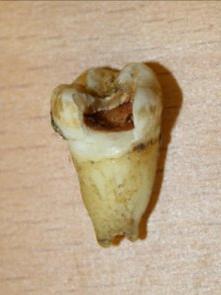
A tooth belonging to former Beatle John Lennon is up for auction at the Omega auction rooms in Stockport in November.  Lot no. 233 is a tooth with a sworn affidavit of authenticity by house-keeper Dot Jarlett, who was given it as a souvenir by Lennon.


A Beatle's tooth. Photo from Omegaauctions.co.uk.

Official documentation doesn't appear to give any information about this tooth though, so I thought I would.  It seems to be a third molar - a wisdom tooth - probably an upper one.  It's hard to tell if it's from the right or left side of the mouth though.  There's also a noticeable cavity, which is probably the reason the tooth was removed back in the 1960s.

However, the cavity is not as substantial as it first appears.  The difference in colour of the tooth enamel from the top of the tooth (off white/yellowish) and the lower part of the 'cavity' (white) is quite substantial.  I'd guess that a small amount of enamel broke off at some point in the last few years.  Perhaps that might surface at auction one day too.

The guide price for this item is an astonishing £10,000 to £20,000.  Whilst it might be unique, it does seem like a lot to pay for something that probably caused its owner a great deal of pain and was given away at the first opportunity.  It probably didn't even inspire him to write songs - not a single Beatles song contains the word 'tooth'!

Wednesday, 7 September 2011

When teeth go wrong!

Sometimes, whilst looking at thousands of teeth, you notice something that isn't quite right. This is one of those things:

A tooth with two crowns and one root... weird, eh?
Looking at the top front teeth (the incisors) in the upper jaw
of a c. 4-6 year old individual. Medieval.
Adult humans generally develop the same number of teeth.  Most of us have (or originally had, prior to dental intervention) four incisors, two canines, four premolars and six molar teeth in our upper and lower jaws.  It's fairly common however, for some teeth to never form (agenesis). For example, up to a third of the population is congenitally missing at least one of their wisdom teeth  - the final molar teeth to erupt.

It's much rarer to see instances of too many teeth (hyperdontia).  And it is rarer still to see teeth like the one in the picture above.  All of the baby teeth form in the womb, ready to erupt in the infant a few months after birth. This starts in the sixth week of embryonic development, when enamel-forming cells imbed themselves into the site of future primary teeth. At this point, not more than eight weeks into development, a genetic mutation must have occurred to produce such a tooth. Perhaps too many tooth buds initiated, perhaps one divided into two.

Of course, in all likelihood this unusual looking tooth wasn't even noticed, by the child or his family.  Had the child lived, it would have been replaced by the permanent teeth coming through about six years later and we would have never seen it.