Showing posts with label dental pain. Show all posts

Wednesday, 5 December 2012

Kissing a donkey and spitting on a frog!

In the throes of agonising toothache, could you imagine kissing the teeth of a living donkey in an attempt to cure yourself? If you can't, that's understandable - but it's exactly what you would have done in the 14th century... and much more besides.

The cures for toothache in the past are difficult to believe and some of them are difficult to stomach. From spitting into the mouth of frog in the hope it would take on your pain for itself to sucking on the freshly extracted tooth of a dead man, past populations would try anything to alleviate the pain of cavities and gum disease.

Until the germ theory of disease was discovered in the late 19th century, how teeth became cavity ridden was a mystery. In 1890, WD Miller discovered that bacteria lived on the surface of the teeth and their acidic waste products could erode the enamel. Prior to this discovery, common lore attributed cavities to a tooth worm. The worm was a popular explanation for dental problems across the globe throughout the ages.  Ancient Babylonian priests are purported to have called upon the sun god Ra to summon the worm for them so that they could banish it with a curse and medieval Europeans would try to smoke the worms out by taking in the (poisonous) fumes of henbane.

Here be monsters: tooth worms and eternal suffering.


Animals, as with many folk cures, lose out in this situation, with common traditional cures for toothache in England including: wearing a necklace made of mole paws and noses, cutting spines off a dogfish or rubbing the afflicted teeth with the burnt brain of a hare or the horn of a hart. Apparently, hare brains rubbed into the gums were also used to aid the safe eruption of infants' teeth. Lovely.

Nineteenth century Americans would even bite snakes, including deadly rattlesnakes, in an attempt to get rid of their toothache. I'm pretty sure that the threat of getting bitten by a rattler would definitely take your mind off the tooth pain, so at least this one might have worked for a short time...


References:
The Teeth in Folklore (1968), Jeri Tanner
Folklore of the Teeh (1934), Leo Kanner
Of the Teeth  (1961), Byrd Howell Granger


Monday, 24 September 2012

Beeswax and broken teeth...

Going to the dentist for a filling is generally considered to be a modern invention - but a 6500 year old jaw fragment found in Slovenia may be about to change that idea.

The unassuming fragment of mandible was excavated from a cave in the early 20th century, catalogued and filed away in an Italian museum until it was reinvestigated by Claudio Tuniz and Federico Bernardini of the International Centre for Theoretical Physics in Trieste, who were using samples from the museum to test new x-ray imaging techniques. Once the mandible fragment had been scanned however, an unusual substance was noticed adhering to the surface of a canine tooth.

The Lonche Jaw; part of the lower left dental arcade
belonging to a 6500 year old human. Scale bar 10mm.
Photo from doi:10.1371/journal.pone.0044904.g001
High resolution scans revealed a long vertical crack in the tooth and an exposed area of dentine - the material that sits beneath enamel in the tooth - with this other substance covering the occlusal (biting) surface of the tooth and filling the crack.

Further tests of the filling material discovered that it was beeswax, and subsequent radiocarbon dating found that it was contemporary with the mandible. Although it is possible that the beeswax was applied just after death as part of a ritual, it seems likely that the wax was acting as a filling to numb dental pain. If this is the case, it represents one of the earliest examples of dental-palliative care. Beeswax, which can have anti-bacterial and anti-inflammatory properties was known and used by prehistoric populations, and it is not inconceivable that this kind of dental care was at least sporadically practised.

It is interesting to wonder about how many more examples of such dental care exist in museums across the globe - after all, this particular mandible fragment lay filed away for 101 years before the beeswax addition was noticed...


References:
Bernardini et al  2012 'Beeswax as Dental Filling on a Neolithic Human Tooth' in PLOS ONE.
Barras, C 2012 'Oldest dental filling is found in a Stone Age tooth' in New Scientist Online


Tuesday, 9 August 2011

Tweeth

Having been glued to the microblogging site Twitter for the last 24 hours watching the 'rioting' events take place in London, I've been surprised by how people are using such a service. There are people both condemning and inflaming the situation, personal messages about what's going on and public words of warning, of places to avoid and so on.

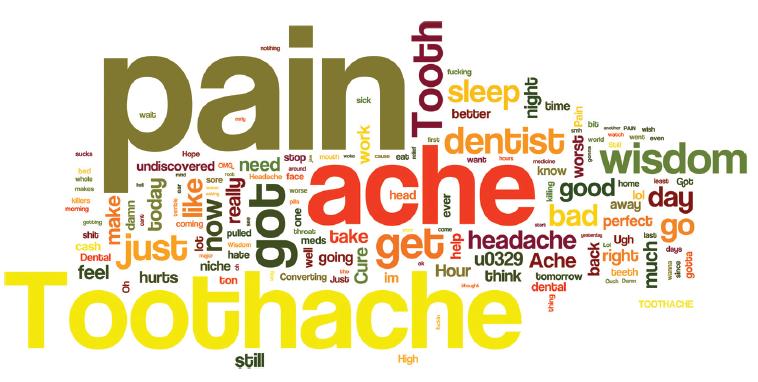
What this has to do with teeth of course, is very minimal. But it reminded me of a recent article in the Journal of Dental Research about using social media and microblogging sites like Twitter to carry out 'public health surveillance'.  Researchers analysed 772 random and unique (but tooth related) updates from Twitter users to see how such a site could was being used to disseminate information about dental pain.  Since tweets are limited to 140 characters in length, users update more frequently in real-time, indicating that it could be a useful rolling data source.

The collected tweets were placed into various categories - statements of general pain and discomfort, or a report of action taken in response to that discomfort, for example.  Unsurprisingly for a blogging website, general statements of pain were the most frequently observed updates (83%).  Of those who tweeted about taking action (22%), most employed or desired the services of a dentist or some sort of medication.  Interestingly, 14% of the updates were seeking advice for relief of their dental pain.

Word cloud created from the tweeted information. The larger the word, the more frequently it appears. From Heaivilin et al: 2011.

Although such a method of data collection has its limitations, it is important to acknowledge that user generated content of this nature is growing in popularity. If people are sharing such information online and asking for help and advice about dental pain (and one assumes other conditions too) it might be a sign that medical professionals should consider interacting more with the medium.  Heaivilin et al acknowledge that as dental professionals, they might "need to act quickly to ensure that [they] are part of the conversation."

As an aside, it has also made me realise that ordinary, every day updates on sites like Twitter and Facebook can be easily used to harvest information like that in the article. I wonder who else is listening to these 'conversations', how they are analysing them and what other articles are being written about them, as we tweet...

References:
N. Heaivilin, B. Gerbert, J. E. Page, J. L. Gibbs. Public Health Surveillance of Dental Pain via Twitter. Journal of Dental Research, 2011; DOI: 10.1177/0022034511415273