Showing posts with label blogging. Show all posts

Tuesday, 29 May 2012

Sex, teeth and syphilis...

Perusing through the British Dental Journal (BDJ) this morning, I noticed an article about syphilis (one of the more exciting sexually transmitted diseases) which I thought might be worth reading. From an osteological point of view, syphilis is one of the most interesting conditions to find in an individual because, left without treatment, it manifests in a number of horrible ways in the skeleton. The disease, caused by the Treponema pallidum organism eventually leads to skeletal lesions such as 'caries sicca', the pitting and whole-scale destruction of the skull through necrosis of the bone, amongst other things.

Figure 1: Caries sicca, the destruction of the frontal bone of the skull.
Image courtesy of the Cambridge Encyclopaedia of Palaeoanthropology, pp 161.


Syphilis can also be transmitted from mother to fetus, leading to a congenital form of the disease. Although it can cause a variety of developmental problems, from an osteological and dental point of view, it is the manifestation of 'Hutchinson's teeth' that are most diagnostic. The front teeth of such individuals are deformed and notched in a peculiar way - the result of particular kinds of bacteria called spirochetes inhibiting bone formation in the developing child.

So, why did the article in the BDJ inspire this blog? Mostly because it's a bit on the scary side. The cases of syphilis in the UK increased by 951% between 1999 and 2008. Although initially curable, the disease only presents a brief lesion at first (the chancre, which can appear at the point of infection), followed by a rash and sometimes - up to 50 years later - the bone changes mentioned above. Ignoring the initial appearance of the disease is probably a bad thing to do, then.

Jones et al (2012) discuss three case studies of the disease, pointing out that the initial presentation of the disease may occur in the oral cavity, in the form of a painful ulcer or lesion. Although the appearance will vary from one individual to the next, it can look a bit like this:

Figure 2: A syphilitic chancre on the tongue.
(Reprinted from the New England Journal of Medicine
without permission.  Ahem.)

The article states that the 'significant increase of syphilis and its high infectivity require the dental profession to increase their awareness of sexually infectious diseases and the appropriate dental management' (Jones et al 2012: 477), a useful recommendation, considering the rise in the number of cases in recent years.

However, I would like to increase everyone's awareness of the really horrible things that can happen if you're not careful with your sexy times. Because as fun as things might seem at the time, having your bone become infected and rot away, sending you slowing insane, probably isn't worth it in the end. So remember:

Figure 3: Yep, all of them. Including that one a few rows
back on the right. Especially him.

References:
Jones et al 2012. Three cases of oral syphilis – an overview. 
Available at: http://www.nature.com/bdj/journal/v212/n10/full/sj.bdj.2012.420.html#f2


Tuesday, 9 August 2011

Tweeth

Having been glued to the microblogging site Twitter for the last 24 hours watching the 'rioting' events take place in London, I've been surprised by how people are using such a service. There are people both condemning and inflaming the situation, personal messages about what's going on and public words of warning, of places to avoid and so on.

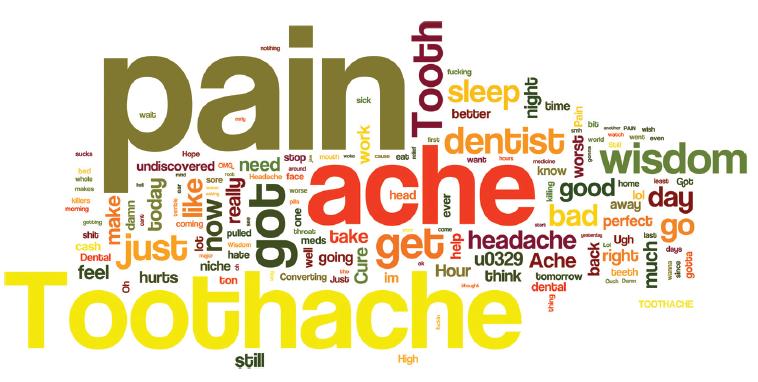
What this has to do with teeth of course, is very minimal. But it reminded me of a recent article in the Journal of Dental Research about using social media and microblogging sites like Twitter to carry out 'public health surveillance'.  Researchers analysed 772 random and unique (but tooth related) updates from Twitter users to see how such a site could was being used to disseminate information about dental pain.  Since tweets are limited to 140 characters in length, users update more frequently in real-time, indicating that it could be a useful rolling data source.

The collected tweets were placed into various categories - statements of general pain and discomfort, or a report of action taken in response to that discomfort, for example.  Unsurprisingly for a blogging website, general statements of pain were the most frequently observed updates (83%).  Of those who tweeted about taking action (22%), most employed or desired the services of a dentist or some sort of medication.  Interestingly, 14% of the updates were seeking advice for relief of their dental pain.

Word cloud created from the tweeted information. The larger the word, the more frequently it appears. From Heaivilin et al: 2011.

Although such a method of data collection has its limitations, it is important to acknowledge that user generated content of this nature is growing in popularity. If people are sharing such information online and asking for help and advice about dental pain (and one assumes other conditions too) it might be a sign that medical professionals should consider interacting more with the medium.  Heaivilin et al acknowledge that as dental professionals, they might "need to act quickly to ensure that [they] are part of the conversation."

As an aside, it has also made me realise that ordinary, every day updates on sites like Twitter and Facebook can be easily used to harvest information like that in the article. I wonder who else is listening to these 'conversations', how they are analysing them and what other articles are being written about them, as we tweet...

References:
N. Heaivilin, B. Gerbert, J. E. Page, J. L. Gibbs. Public Health Surveillance of Dental Pain via Twitter. Journal of Dental Research, 2011; DOI: 10.1177/0022034511415273