Showing posts with label teeth. Show all posts

Tuesday, 20 October 2015

Leave it, it's not worth it?

Warning: contains mostly me. 

I suppose I should make a comment about blowing dust off this thing, since it's been a full two years since I last posted in it. The second to last post on here is about giving my PhD one last shot... which I did for a bit, then decided it was all too much and I took a 'career break' much to the chagrin of people invested in me as a PhD candidate, and I went away for a bit. (It was definitely a career break, I definitely wasn't just running away. Nope.) I wanted to see what it was like being somewhere else for a bit and see if I could heal some of the bits of me that were broken... and I suppose I did to a certain extent, so that's nice.

Of course, I came back eventually and after a few weeks enjoying the UK again (it's possible, I assure you. I had a year without a roast dinner. What kind of year is that?!) and then I decided to bite the bullet and return to Sheffield full time, to my department and give the PhD one last shot. Again. That was an interesting decision, to be honest. Even after a year away I couldn't give it up! Imagine that!

But sadly, I find myself having problems once again though (because life is never easy), but they are slightly different this time. Whether that's better or worse, I don't know. So, I thought I'd talk about them a bit.


Friday, 29 March 2013

If at first you don't succeed?

This is going to be a bit of a departure from the usual toothy shenanigans I tend to bring to this blog. Instead I am going to write a little bit about my PhD, inspired by a recent post by the charming but palaeontology crazed Jon Tennant over at Green Tea & Velociraptors. I have to say, his thoughts on the subject are a bit more positive than mine are going to be...

I am in the fourth year of my doctoral studies. It's euphemistically called your 'writing-up' year. Of course, in my discipline you're expected to finish completely within three years - consequently, the fourth year is unfunded and mostly unsupported by your institution. Although a lot of people stray over their three year allowance, it's seen as a bit of an academic faux pas. It gets worse if you take longer than that of course. If you take more than four years you become spoken of in hushed tones in darkened corridors as a warning to others.

I like to think of it not so much as a writing-up year, but a period of existing on very little income, caught between needing a job before you run out of rent money and finishing a thesis you despise. And yes, I do despise it. I love my subject, and I love the gubbins that a PhD entails - the teaching, the outreach, the learning and the kind of day-to-day intellectual interaction you get exposed to... but the PhD itself? I'm not so keen on that and I don't think I have been for a long, long time.


It's safe to say that my experience of undertaking a PhD has not been ideal. Just before my it kicked off, the long term relationship I was in failed epically and miserably, I quickly moved into a horrible shared house and soon after I became ill. It was a like building a castle upon a bowl of jelly - so think of this as full disclosure - it was probably never destined to work out well for me.

My initial supervisor was an eminent professor and a genuinely lovely person, but unfortunately, not the kind of supervisor I needed at the time. Turns out that 'hands-off' is not the mode of supervision someone like me needed - but I wasn't really in a state to let anyone know that. So, I wandered aimlessly for a long time in the vast fields of academia, producing work of variable quality, hoping it would eventually click and I would manage to produce something of consequence.

The saddest thing is that no-one noticed. I accidentally bluffed my way through every upgrade, every progress report and presentation I had to give. I have no idea how, but not a single person for two years noticed. I take full responsibility for that of course. If you don't throw your hands up whilst you drown, it's not always possible for passers-by to see you as you slip 'neath the waves.

 http://mariovittone.com/wp-content/uploads/2010/05/drowning.jpg

In the last year, things started to change. I have a different supervisor, a better home life and my progress over the past year has been phenomenal compared to my first two - but I'm still running just to keep up. It's not fulfilling and it does not make me happy. Every word I write still feels like a struggle (ironically, it's a bit like pulling teeth), but since I am two chapters away from being able to hand in, I've decided to keep on at it. At least until summer. It's a precarious decision, but I've always been a 'regret something you did, rather than something you didn't do' kind of girl, so here goes. I have a few more months to get it together and hand the bloody thing in. Wish me luck!

In an attempt to do something other than whine on the internet though, I thought I might present a few words of advice for people undertaking a PhD, just in case anything I have learnt might help. So, here goes:
  • Money. If you want to do a PhD, please, please, make sure you have enough funding or other income to allow you to do it without worrying about rent and bills and how to afford shoes. I had very minimal scholarship funding, which I was very grateful for - but I thought it would get me through if I was careful with it. It didn't.
  • Support. You might be a devil-may-care rogue of a person, a lone wolf who only needs themselves - but if, like me, you are not, I suggest not doing a PhD without a good support network of family, friends and colleagues around you. Lonely nights and a lack of human conversation do not a happy worker make.
  • Seeking help. If you find yourself struggling, talk to someone, anyone in your department. I wanted to hide my situation in case they got rid of me, but it did me no favours in the end. No-one actually expects you to be infallible.
  • Be brave. If you do not have a supervisor that suits your working style or your nature (for want of a better word) and you feel like someone else might be better, change. I was told it was ' too political' to do such a thing - but fuck it. Change and find the support system you need. It's your PhD, not the PhD of some coffee room know-it-all.
  • Failure. I wish I had recognised a long time ago that failure has a lot of different meanings. I realise now 'dropping out', what I saw as my ultimate failure, wouldn't have been so bad to do in the first couple of years. It's actually only a failure if you make it into one. Lots of people do just fine without a doctorate :)
So, there you go. That's my doctoral experience. Lots of people have fantastic, wonderful experiences, but it's worth noting that it's not a given. If you find this because you are struggling with your studies, that's okay. You can do it! By the same measure, if you really don't want to do it any more, that's fine too.

Do what makes you the most happy.

Linzi

Tuesday, 15 January 2013

Get me a guard and make it snappy...

Earlier this month, a 5ft long reptile called 'Mr Teeth' was found protecting a large stash of cannabis in the home of Assif Mayar in Oakland, California. The creature, initially thought to be an alligator was soon identified as a caiman by local veterinarians.

The unfortunate reptile, unexpectedly discovered in the wake of a drugs raid, has since died at Oakland Zoo. Mr Teeth had been kept in poor conditions for many years, confined to a 8-foot-by-2-foot plexiglass tank. He was originally bought by Mr Mayar to 'commemorate the death of rapper Tupac Shakur' in 1996, according to a police spokesperson at the Oakland Police Department. 

As well as significant drugs charges, the caiman's ex-owner is now set to face additional animal cruelty charges in the wake of Mr Teeth's untimely death.


Mr Teeth. RIP.

Tuesday, 8 January 2013

My, what exoskeleton crushing teeth you have!

A bird with some seriously robust teeth has been unearthed recently in Liaoning province, China. The fossilised remains of Sulcavis geeorum are described in the January issue of the Journal of Vertebrate Paleontology and show some unusual dental morphology - not only does this bird have teeth, but they're sharply pointed with distinct grooves on the inside surface.

This sparrow-sized flier, which belonged to the enantiornithine group of toothed birds, lived between 121 and 125 million years ago, consuming a diet of smaller hard-shelled creatures such as insects or crabs.

As rare as hen's teeth might be today, it seems that the group to which this bird belonged to were evolving new and toothy ways to exploit a variety of ecological niches - at a time when other birds were losing their dentitions.

Although small, this bird and it's relatives were certainly toothsome. I like to think of them as Darwin finches with attitude...
 

Sulcavis geeorum skull, a fossil bird from the Early Cretaceous.
Photo by Stephanie Abramowicz. Scale bar in mm.


Wednesday, 5 December 2012

Kissing a donkey and spitting on a frog!

In the throes of agonising toothache, could you imagine kissing the teeth of a living donkey in an attempt to cure yourself? If you can't, that's understandable - but it's exactly what you would have done in the 14th century... and much more besides.

The cures for toothache in the past are difficult to believe and some of them are difficult to stomach. From spitting into the mouth of frog in the hope it would take on your pain for itself to sucking on the freshly extracted tooth of a dead man, past populations would try anything to alleviate the pain of cavities and gum disease.

Until the germ theory of disease was discovered in the late 19th century, how teeth became cavity ridden was a mystery. In 1890, WD Miller discovered that bacteria lived on the surface of the teeth and their acidic waste products could erode the enamel. Prior to this discovery, common lore attributed cavities to a tooth worm. The worm was a popular explanation for dental problems across the globe throughout the ages.  Ancient Babylonian priests are purported to have called upon the sun god Ra to summon the worm for them so that they could banish it with a curse and medieval Europeans would try to smoke the worms out by taking in the (poisonous) fumes of henbane.

Here be monsters: tooth worms and eternal suffering.


Animals, as with many folk cures, lose out in this situation, with common traditional cures for toothache in England including: wearing a necklace made of mole paws and noses, cutting spines off a dogfish or rubbing the afflicted teeth with the burnt brain of a hare or the horn of a hart. Apparently, hare brains rubbed into the gums were also used to aid the safe eruption of infants' teeth. Lovely.

Nineteenth century Americans would even bite snakes, including deadly rattlesnakes, in an attempt to get rid of their toothache. I'm pretty sure that the threat of getting bitten by a rattler would definitely take your mind off the tooth pain, so at least this one might have worked for a short time...


References:
The Teeth in Folklore (1968), Jeri Tanner
Folklore of the Teeh (1934), Leo Kanner
Of the Teeth  (1961), Byrd Howell Granger


Tuesday, 27 November 2012

Wearing your teeth on your sleeve?

One thing I have noticed in the last few years of my self-imposed tooth obsession, is how often teeth get used for art and decoration. On this occasion, it is the glitter encrusted pop princess Ke$ha, famous for brushing her gold plated gnashers with Jack Daniels, who is re-appropriating teeth.

Last year the 25 year old singer put out a Twitter based request for each of her three million fans to send her some of their unwanted teeth and even provided a PO Box for them to do so. As is the way of crazed fans, she received thousands of teeth in the mail.

And the reason? Frivolous accessories, of course! Ke$ha made the donated teeth into a bra-top, a headdress, necklaces and earrings. According to this interview with MTV she's even worn the outfit out, proving that not only are teeth essential to human health and wellbeing, but they're fashionable too.


http://cdn.popdust.com/wp-content/uploads/2012/09/Sticky-Lady-Gaga-Naked-Teeth-Brushing01-659x441.jpg
Ke$ha's dentists get angry when she continues to ignore their advice to
stop using alcohol to brush her teeth and to start using a fluoride toothpaste.


Tuesday, 21 August 2012

Dental heath, dental care and dementia

Regularly cleaning your teeth and keeping your gums healthy could help lower your risk of succumbing to dementia later in life, according to a recent US study.

Researchers at the University of California collected health data regarding the dental health and dental habits of over 5000 individuals living in a large retirement community over a period of 18 years. The participants of the study were all dementia free at the outset of the study in 1992, and of them, around 27% were diagnosed with dementia by 2010.

The results were interesting. The individuals with teeth, who did not brush their teeth daily were up to 65% more likely to develop dementia than those who brushed multiple times a day - although this link was only statistically significant in women. Not visiting the dentist regularly (i.e. a lack of dental upkeep and supervision) was also associated with an increased dementia risk.

Although this study is limited and does not establish an explicit causal link between dental health and dementia, it could suggest that 'retaining adequate masticatory function through regular oral hygiene and use of dentures may reduce risk of dementia' (Paganini-Hill et al. 2012), with further studies required to identify exactly how and why dental health and dementia are connected.

There are certainly mechanisms by which such a link could exist. For example, the brains of Alzheimer sufferers have been found to contain more species of the oral Treponema bacteria than the brains of control groups. This may indicate that it is partly or occasionally the inflammatory responses of the body and brain to these pathogens which are responsible for illness.

In the context of the ever-ageing populations of the developed world, it's probably a good call to investigate the associations between dental and overall health - after all, keeping an elderly population in tip-top mental shape might be as simple as promoting a holistic approach to health - which includes regular tooth brushing!


Paganini-Hill, A. et al. 2012. Dentition, Dental Health Habits, and Dementia: The Leisure World Cohort Study. In the Journal of the American Geriatrics Society, Volume 60, Issue 8. 
Available here. 

Friday, 10 August 2012

Teeth where teeth should not be...

After 23 years of abnormal swelling in her left eye, Nagabhushanam Siva decided to let doctors in Chennai, southern India investigate her condition.  A tumour was diagnosed and an operation was undertaken, only to reveal the presence of two fully formed teeth within the tumour itself. Unfortunately, the tumour had been in place for too long, placing pressure on the optic nerve and leaving it permanently damaged - thus the operation was not successful, leaving Siva blind.

Teeth in the tumour, seen during surgery.
(Cover Asia Press)
This kind of tumour is usually present from birth and is called a 'mature teratoma'*. Disturbingly, they can contain all sorts of misplaced tissue - including hair, teeth and bone. In some cases, the growth can include even more complex organs. As I discovered with not a small amount of horror that such a thing as an 'mature ovarian cystic teratoma' can exist. This is often a mass of disorganised tissue within the ovarian region, but can occasionally form into a 'homunculus' with a generalised human form. In one case study from Japan, such a tumour was found to have 'Brain, eye, spinal nerve, ear, teeth, thyroid gland, bone, bone marrow, gut, trachea, blood vessels, and phallic' tissue (Kuno et al. 2003), arranged in a 'well organised' fashion.

Although such tumours are rare, they contain skeletal and dental tissues which could very well survive in archaeological contexts. A brief search of the International Journal of Osteoarchaeology hasn't turned up any clear examples of such a condition in the past, but I think they could be out there. It's certainly something to keep in mind next time I find some teeth where teeth really shouldn't be...


* Wikipedia informs me that a benign tumour of this nature, in the UK is termed a 'mature teratoma', whilst in the US it's simply referred to as a teratoma. In the UK, a 'teratoma' or 'immature teratoma' refers to a malignant tumour.

Monday, 30 July 2012

Plaque and pollen and proteins, oh my!

Do you often wonder what interesting things might be lurking in your mouth when you don't brush your teeth? 

Well, wonder no more! This very interesting interview in the Guardian with Christina Warinner at the Centre for Evolutionary Medicine at the University of Zurich discusses exactly that. Warinner talks about deposits of dental plaque (what we call dental calculus) on teeth and how 'pollen, starch grains, animal muscle, bacteria, even a person's DNA' can be found trapped within it.

If you get a chance, you can watch Warinner's TED talk on YouTube (linked below), which is similarly fascinating and explains how teasing out the preserved protein and DNA from dental calculus can be used to 'investigate the relationship between disease, diet and the environment' in the past - and how that knowledge might benefit us in the future.


Thursday, 10 May 2012

By tooth or by beak...

Researchers at the University of Sheffield and King's College London have discovered that the pufferfish, a highly poisonous but silly looking tropical fish, may hold the key to how and why humans do not replace their teeth in adulthood - which may in turn lead to advances in dental treatments.

Certain adult pufferfish have a parrot like 'beak' with a distinct cutting edge. This beak is formed by bands of dentine which continually grow to replace those lost through feeding.  In young pufferfish, the beak is not present, instead 'first-generation' teeth develop, only to be replaced by four teeth at the front of the jaw which subsequently make-up the beak structure.

 Figure 1: A, the freshwater pufferfish, Monotrete abei. B, side-view 
showing the large lips covering the beak. C & D, views of the beak itself. 
Photo courtesy of Fraser et al (2012: 2)

According to Dr Gareth Fraser, who led the project, investigating the manner and mechanisms of tooth replacement is of  "great interest for science... to understand the genes that govern the continued supply of teeth and mechanisms of dental stem cell maintenance."

Humans only replace their teeth once, in childhood.  Unlike a shark with its many rows of teeth, or a rat with it's continually erupting ones, humans cannot replace teeth naturally. The much increased longevity of modern human populations is therefore at odds with the single set of trauma-and-disease-prone adult teeth they have. Dr Fraser believes that the knowledge could eventually be used to "facilitate advances in dental therapies" with this in mind. 


References:
Fraser, GJ, Britz, A, Johanson, Z and Smith, M. 2012. Replacing the first-generation dentition in pufferfish with a unique beak. PNAS. 
Available at: http://www.pnas.org/content/early/2012/05/04/1119635109.full.pdf+html
University of Sheffield press release. 
Available at: http://sheffield.ac.uk/mediacentre/2012/pufferfish-gareth-fraser-natural-history-museum-evolution-denistry.html


Tuesday, 27 March 2012

Cow collagen and gum recession...

Gum recession can occur for a variety of reasons, but it is typically associated with poor dental hygiene, over-brushing or mouth based piercings rubbing on the gums. When the loss of gum becomes severe, it is sometimes possible to use gum grafts and surgery to regenerate the gum line, preventing damage to the tooth or tooth root and improving the aesthetic appearance of the dentition.

However, recent research may have dispensed with the need for such surgery. Researchers in Germany and Switzerland have trialled the use of bovine collagen (extracted from the fluid filled sac that surrounds the bovine heart) in humans, to repair the gums of fourteen patients. The collagen was implanted next to the tooth, held in place with surgical thread and left in place to allow the bodies own cells to repair the damage (Figure 1, below).

Figure 1: Showing (A) teeth before treatment, note the multiple recessions above the teeth, (B) shows the incisions created in the gum for (C) the insertion of the collagen and finally (D) demonstrates the healed dentition at six months after intervention. (After Schlee et al. Head & Face Medicine 2012 8:6)

The results have been promising, with the functional and aesthetic appearance of the gum-line improving in many of the patients after a period of six months - in 36 of the 62 recession lesions treated for example, full root coverage was achieved.

So, as odd as it might sound, cow collagen may be the answer to gum recession for people who are unable to have corrective periodontal surgery, if longer term studies prove its staying power. Which is very moo-ving, I think you'll agree.


(Sorry about that. It's the only cow based pun I could come up with.)


References:
Schlee et al. Bovine pericardium based non-cross linked collagen matrix for successful root coverage, a clinical study in humans in Head & Face Medicine 2012 8:6  doi:10.1186/1746-160X-8-6. 
Available at: http://www.head-face-med.com/content/8/1/6
Cow collagen heals gums. Available at http://www.nature.com/bdj/journal/v212/n6/full/sj.bdj.2012.238.html.

Wednesday, 25 January 2012

Tooth and beauty

The role of the media in the well-being of young people in the West has been much discussed in the past few decades, with the popularity of glossy magazines and the exuberant application of Photoshop in them suggested as compounding factors in the rise of eating disorders and cosmetic surgery.

However, looking through some old advertisements for dental products today I realised that not a great deal seems to have changed in the last half century or so. This Colgate toothpaste advertisement came out in 1947:


Apparently even in the 1940s, manufacturers were focussing on what sells - the fear of social exclusion and not being loved. The woman featured is destined to be alone and to be the target of hushed gossip, all because she doesn't use the right toothpaste. Compare this to any clothing, car or perfume advert on television now, which all promote an in-crowd and how a particular product can make you part of it.

The reference to 'scientific tests' is quite good too, with 7 cases out of 10 of 'Oral Offence' being prevented by using Colgate Dental Cream. Sounds about as scientific as the wonderfully named 'nutrileum' and 'pentapeptides' and so on which animatedly feature in modern shampoo adverts, eh?

Friday, 6 January 2012

Death by Mortification

During the 16th and 17th centuries, plague swept through England causing huge changes to the size and make-up of the population. It was deemed necessary for the first time, to record the numbers and nature of deaths in the capital. The first record of this type commenced in London on January 1st 1564 and ended the last day of December the following year. In that time 23,630 deaths were recorded, 20,136 of which were listed as plague deaths.

Cause of death continued to be recorded in subsequent years, eventually forming the 'London Bills of Mortality', which, whilst lacking a certain medical expertise, certainly provide a good read.  Look at this one from 1806 / 1807. Some recognisable causes of death are present; small pox killed 1297 people, old age carried off 1424 and cancer 83 for example.

However, there are a few odd and unusual ones worth mentioning. Mortification (the death of part of the body, probably in the manner of gangrene) did away with 210 individuals, whilst the Rising of the Lights (a spookier sounding condition there is not) killed one unlucky Londoner. Saint Vitus's Dance, an infectious disease causing jerky movements, also killed a single person. Four unfortunate people were apparently Frighted to death.

Of interest to me (of course) are the deaths attributed to 'Teeth', which amounted to 322 in 1806. Teeth were therefore the tenth most common cause of death that year. In other years 'teeth' made it to the fifth or sixth most common cause of death with hundreds dying from infections originating from abscesses and advanced gum disease. If we compare this to the modern day, deaths from tooth based infections are very rare - just eight people in the UK had dental related deaths in 2005. Oddly though, that's four more than were killed by some kind of unspecified 'Evil' two hundred years earlier...

Tuesday, 8 November 2011

Love, love me tooth... an update!

John Lennon's decayed tooth fetched the grand sum of £19,000 at auction last week. Unconfirmed reports have suggested that the buyer was a dentist from Canada - which I hope this means it was bought as an investment to lure more people into his practice. The idea that it was bought for not much less than the average graduate wage in the UK, for pleasure, is a bit strange.

But, by using the power of maths, we now know how much John Lennon's mouth was worth!

£608,000*

Impressive, I think you'll agree...


* That's 32 (the number of teeth in most adult human mouths) multiplied by £19,000, fact fans!

Monday, 31 October 2011

Love, love me tooth...

A tooth belonging to former Beatle John Lennon is up for auction at the Omega auction rooms in Stockport in November.  Lot no. 233 is a tooth with a sworn affidavit of authenticity by house-keeper Dot Jarlett, who was given it as a souvenir by Lennon.


A Beatle's tooth. Photo from Omegaauctions.co.uk.

Official documentation doesn't appear to give any information about this tooth though, so I thought I would.  It seems to be a third molar - a wisdom tooth - probably an upper one.  It's hard to tell if it's from the right or left side of the mouth though.  There's also a noticeable cavity, which is probably the reason the tooth was removed back in the 1960s.

However, the cavity is not as substantial as it first appears.  The difference in colour of the tooth enamel from the top of the tooth (off white/yellowish) and the lower part of the 'cavity' (white) is quite substantial.  I'd guess that a small amount of enamel broke off at some point in the last few years.  Perhaps that might surface at auction one day too.

The guide price for this item is an astonishing £10,000 to £20,000.  Whilst it might be unique, it does seem like a lot to pay for something that probably caused its owner a great deal of pain and was given away at the first opportunity.  It probably didn't even inspire him to write songs - not a single Beatles song contains the word 'tooth'!

Wednesday, 7 September 2011

When teeth go wrong!

Sometimes, whilst looking at thousands of teeth, you notice something that isn't quite right. This is one of those things:

A tooth with two crowns and one root... weird, eh?
Looking at the top front teeth (the incisors) in the upper jaw
of a c. 4-6 year old individual. Medieval.
Adult humans generally develop the same number of teeth.  Most of us have (or originally had, prior to dental intervention) four incisors, two canines, four premolars and six molar teeth in our upper and lower jaws.  It's fairly common however, for some teeth to never form (agenesis). For example, up to a third of the population is congenitally missing at least one of their wisdom teeth  - the final molar teeth to erupt.

It's much rarer to see instances of too many teeth (hyperdontia).  And it is rarer still to see teeth like the one in the picture above.  All of the baby teeth form in the womb, ready to erupt in the infant a few months after birth. This starts in the sixth week of embryonic development, when enamel-forming cells imbed themselves into the site of future primary teeth. At this point, not more than eight weeks into development, a genetic mutation must have occurred to produce such a tooth. Perhaps too many tooth buds initiated, perhaps one divided into two.

Of course, in all likelihood this unusual looking tooth wasn't even noticed, by the child or his family.  Had the child lived, it would have been replaced by the permanent teeth coming through about six years later and we would have never seen it.

Tuesday, 9 August 2011

Tweeth

Having been glued to the microblogging site Twitter for the last 24 hours watching the 'rioting' events take place in London, I've been surprised by how people are using such a service. There are people both condemning and inflaming the situation, personal messages about what's going on and public words of warning, of places to avoid and so on.

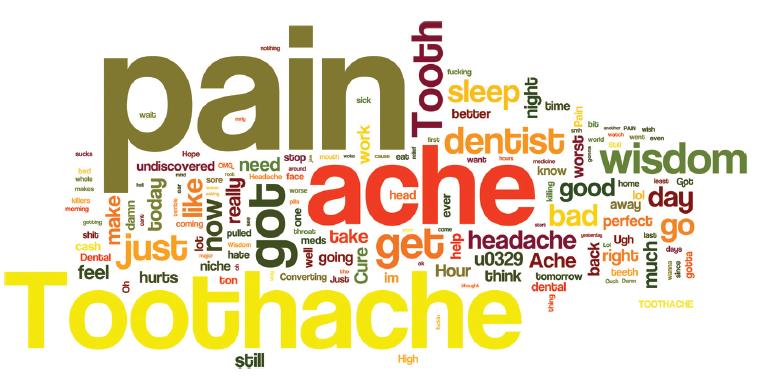
What this has to do with teeth of course, is very minimal. But it reminded me of a recent article in the Journal of Dental Research about using social media and microblogging sites like Twitter to carry out 'public health surveillance'.  Researchers analysed 772 random and unique (but tooth related) updates from Twitter users to see how such a site could was being used to disseminate information about dental pain.  Since tweets are limited to 140 characters in length, users update more frequently in real-time, indicating that it could be a useful rolling data source.

The collected tweets were placed into various categories - statements of general pain and discomfort, or a report of action taken in response to that discomfort, for example.  Unsurprisingly for a blogging website, general statements of pain were the most frequently observed updates (83%).  Of those who tweeted about taking action (22%), most employed or desired the services of a dentist or some sort of medication.  Interestingly, 14% of the updates were seeking advice for relief of their dental pain.

Word cloud created from the tweeted information. The larger the word, the more frequently it appears. From Heaivilin et al: 2011.

Although such a method of data collection has its limitations, it is important to acknowledge that user generated content of this nature is growing in popularity. If people are sharing such information online and asking for help and advice about dental pain (and one assumes other conditions too) it might be a sign that medical professionals should consider interacting more with the medium.  Heaivilin et al acknowledge that as dental professionals, they might "need to act quickly to ensure that [they] are part of the conversation."

As an aside, it has also made me realise that ordinary, every day updates on sites like Twitter and Facebook can be easily used to harvest information like that in the article. I wonder who else is listening to these 'conversations', how they are analysing them and what other articles are being written about them, as we tweet...

References:
N. Heaivilin, B. Gerbert, J. E. Page, J. L. Gibbs. Public Health Surveillance of Dental Pain via Twitter. Journal of Dental Research, 2011; DOI: 10.1177/0022034511415273


Wednesday, 13 July 2011

False teeth?

In the 18th century it was common practise to extract an unhealthy tooth from an individual and replace it with the tooth of a willing and hopefully well paid volunteer.  As unlikely as it sounds, this worked, at least occasionally.  Even now, teeth that have been displaced or knocked out can be eased back into the socket of the jaw (of their original owner, of course) and sometimes heal very well.

You'll be pleased to know however that you need no longer worry (if you ever did) about having a friends tooth forced into your dental arcade. Recent work at the Tokyo University of Science in Japan has shown that a bioengineered mouse molar tooth, grown from embryonic cells and subsequently transplanted into a jaw can successfully 'take root' and restore bone volume in the jaw.  This is the first time a complete organ has been created and transplanted in such a manner.

The transplanted tooth (bottom row) well healed and looking 
good after 45 days.  Note the lack of tooth and surrounding bone tissue in the 
control specimen,which cannot repair or replace itself.
(Image Takashi Tsuji, Tokyo University of Science)


The tooth was grown in a lining around the kidney of an adult mouse, a method which limits its application to humans at this point. However, the signs are good that one day losing teeth and the surrounding supporting tissues may not be such a bad thing - you may be able to get your very own teeth to be grown to order, using your own cells.

It's probably wise not to throw away your dentures just yet however - it's probably going to take a while to perfect the technique for application in humans.


References:
http://www.plosone.org/article/info%3Adoi%2F10.1371%2Fjournal.pone.0021531
http://www.newscientist.com/article/dn20682-artificial-tooth-transplanted-into-mouse.html

Tuesday, 12 July 2011

Decapitations and modified Viking teeth...

In 2009, archaeologists in Weymouth, way down on the south coast of England, found a mass grave containing 54 bodies and 51 skulls. Radiocarbon dating has placed the assemblage in the 10th or early 11th century - and isotopic evidence gleaned from testing the tooth enamel of the individuals within the burial pit has revealed a cold climate origin for them all. One of them may have even grown up somewhere in the Arctic circle.  Such a group is likely then, to be a Viking raiding party - a party that was somewhat curtailed by being rounded up, stripped, hacked to death, decapitated and thrown into a large pit.  That'll teach them to go raping and pillaging, I suppose.

Heads, not attached to the people they originally were attached to...

Of particular interest though, is the teeth of one of these young Viking warriors. There are a series of distinct horizontal lines on the front teeth which may indicate deliberate modification of the teeth. Teeth can frequently become notched and altered by repetitive movement (holding twine between your teeth, or smoking a pipe for example) but this usually affects the working surfaces of the teeth, or the areas between them, not the outward face of the tooth. These lines seem to have been filed into the teeth for some reason.

Two front teeth: All I wanted for Christmas

Deliberate tooth modification is not unknown in human cultures around the world, but it is fairly unusual in Europe. Groups from Africa and Southeast Asia are well known for intentionally removing teeth, chipping and filing them or insetting them with other materials such as brass or shell, blackening them with natural dyes or incising them. Such acts may be undertaken to show group affiliation, identity, or perhaps personal achievement within the tribe or nation.  There is no reason to expect the Vikings were any different in their reasons for practising this kind of modification.  It is even possible they picked up the idea from interactions with native north Americans on their legendary travels across the globe.

If we imagine that these incised lines were once filled in with some sort of dark pigment, designed to make the unusual modification stand out from a distance, it is very likely that the warrior who owned them cut a terrifying figure to the people of ancient Weymouth. 

Didn't really do him much good in the end though.


References:
http://www.bbc.co.uk/news/uk-england-dorset-14019172, pictures taken from the BBC video.

Thursday, 26 May 2011

Milk teeth...

...or 'Why I thought a blog might be a nice idea.'

Somewhere in the depths of a dusty lab, tucked away in an archaeology department in the north of England lurks a woman studying for a PhD in teeth.  She spends every day examining the little bundles of enamel and dentine, thinking it might be nice to share some of the things she looks at and reads every day with other people - you know, things about science and archaeology and what people in the past might have been like.

How do I know this person exists?

Because this person... is me!

Stay tuned for more interesting posts. Hopefully.