 |
| Unusual suspects: Erroneously discarded dentures (Photo courtesy of Severn Trent Water) |
Monday, 19 December 2011
False Flush teeth...
Severn Trent Water has posted pictures of nine sets of false teeth on their website in an attempt to reunite them with their previous owners. Recovered from a sewage processing site in Shrewsbury, it seems unlikely that many will apply to reclaim them - but Severn Trent is hoping that some people out there will email in and 'nominate their gnashers'.
This unusual festive campaign is part of a drive to stop and make people think about what they discard down sinks and toilets. False teeth are just one of the inappropriate objects found in the sewage system which run the risk of blocking drains and causing flooding. Severn Trent spend over £10 million every year cleaning sewers and clearing blockages - but by showcasing these dentures, they're hoping to raise awareness of the issue - finally getting to the root of the problem!


Monday, 12 December 2011
Art is tooth...
The creators of an art-science sculpture, designed to stimulate debate about stem cell research, have been putting out a call for milk tooth donations from school children across the UK.
The two metre long clear crystal resin sculpture is to be encrusted with the milk teeth of thousands of children, who are being persuaded to part with them on the understanding that a 'tooth token' or letter of explanation will suffice for the traditional financial reimbursement from a visiting tooth fairy.
The project, called PALACES, is a collaboration between artist Gina Czarnecki and Professor Sara Rankin (Imperial College London). It hopes to create a wider understanding about how stem cells within dental pulp (the squishy bit inside your tooth) and other 'discarded body parts' such as umbilical cords or fat from liposuction could be ethically used for regenerative and therapeutic clinical purposes.
If you know anyone - probably around the age of seven - who would like to be involved and send in their milk teeth, go to this page here to download a form to do so. The sculpture will go on display at science events and exhibitions throughout 2012.
The two metre long clear crystal resin sculpture is to be encrusted with the milk teeth of thousands of children, who are being persuaded to part with them on the understanding that a 'tooth token' or letter of explanation will suffice for the traditional financial reimbursement from a visiting tooth fairy.
 |
| The crystal resin 'palace' prior to tooth encrustation (Photo courtesy of the BBC) |
The project, called PALACES, is a collaboration between artist Gina Czarnecki and Professor Sara Rankin (Imperial College London). It hopes to create a wider understanding about how stem cells within dental pulp (the squishy bit inside your tooth) and other 'discarded body parts' such as umbilical cords or fat from liposuction could be ethically used for regenerative and therapeutic clinical purposes.
 |
| A close-up of the baby teeth, the first few of thousands! (Photo courtesy of the BBC) |
If you know anyone - probably around the age of seven - who would like to be involved and send in their milk teeth, go to this page here to download a form to do so. The sculpture will go on display at science events and exhibitions throughout 2012.
Tuesday, 8 November 2011
Love, love me tooth... an update!
John Lennon's decayed tooth fetched the grand sum of £19,000 at auction last week. Unconfirmed reports have suggested that the buyer was a dentist from Canada - which I hope this means it was bought as an investment to lure more people into his practice. The idea that it was bought for not much less than the average graduate wage in the UK, for pleasure, is a bit strange.
But, by using the power of maths, we now know how much John Lennon's mouth was worth!
£608,000*
Impressive, I think you'll agree...
* That's 32 (the number of teeth in most adult human mouths) multiplied by £19,000, fact fans!
But, by using the power of maths, we now know how much John Lennon's mouth was worth!
£608,000*
Impressive, I think you'll agree...
* That's 32 (the number of teeth in most adult human mouths) multiplied by £19,000, fact fans!
Monday, 31 October 2011
Love, love me tooth...
A tooth belonging to former Beatle John Lennon is up for auction at the Omega auction rooms in Stockport in November. Lot no. 233 is a tooth with a sworn affidavit of authenticity by house-keeper Dot Jarlett, who was given it as a souvenir by Lennon.
Official documentation doesn't appear to give any information about this tooth though, so I thought I would. It seems to be a third molar - a wisdom tooth - probably an upper one. It's hard to tell if it's from the right or left side of the mouth though. There's also a noticeable cavity, which is probably the reason the tooth was removed back in the 1960s.
However, the cavity is not as substantial as it first appears. The difference in colour of the tooth enamel from the top of the tooth (off white/yellowish) and the lower part of the 'cavity' (white) is quite substantial. I'd guess that a small amount of enamel broke off at some point in the last few years. Perhaps that might surface at auction one day too.
The guide price for this item is an astonishing £10,000 to £20,000. Whilst it might be unique, it does seem like a lot to pay for something that probably caused its owner a great deal of pain and was given away at the first opportunity. It probably didn't even inspire him to write songs - not a single Beatles song contains the word 'tooth'!
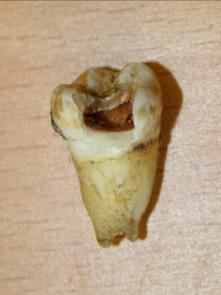 |
| A Beatle's tooth. Photo from Omegaauctions.co.uk. |
Official documentation doesn't appear to give any information about this tooth though, so I thought I would. It seems to be a third molar - a wisdom tooth - probably an upper one. It's hard to tell if it's from the right or left side of the mouth though. There's also a noticeable cavity, which is probably the reason the tooth was removed back in the 1960s.
However, the cavity is not as substantial as it first appears. The difference in colour of the tooth enamel from the top of the tooth (off white/yellowish) and the lower part of the 'cavity' (white) is quite substantial. I'd guess that a small amount of enamel broke off at some point in the last few years. Perhaps that might surface at auction one day too.
The guide price for this item is an astonishing £10,000 to £20,000. Whilst it might be unique, it does seem like a lot to pay for something that probably caused its owner a great deal of pain and was given away at the first opportunity. It probably didn't even inspire him to write songs - not a single Beatles song contains the word 'tooth'!
Wednesday, 7 September 2011
When teeth go wrong!
Sometimes, whilst looking at thousands of teeth, you notice something that isn't quite right. This is one of those things:
Adult humans generally develop the same number of teeth. Most of us have (or originally had, prior to dental intervention) four incisors, two canines, four premolars and six molar teeth in our upper and lower jaws. It's fairly common however, for some teeth to never form (agenesis). For example, up to a third of the population is congenitally missing at least one of their wisdom teeth - the final molar teeth to erupt.
It's much rarer to see instances of too many teeth (hyperdontia). And it is rarer still to see teeth like the one in the picture above. All of the baby teeth form in the womb, ready to erupt in the infant a few months after birth. This starts in the sixth week of embryonic development, when enamel-forming cells imbed themselves into the site of future primary teeth. At this point, not more than eight weeks into development, a genetic mutation must have occurred to produce such a tooth. Perhaps too many tooth buds initiated, perhaps one divided into two.
Of course, in all likelihood this unusual looking tooth wasn't even noticed, by the child or his family. Had the child lived, it would have been replaced by the permanent teeth coming through about six years later and we would have never seen it.
 |
| A tooth with two crowns and one root... weird, eh? Looking at the top front teeth (the incisors) in the upper jaw of a c. 4-6 year old individual. Medieval. |
It's much rarer to see instances of too many teeth (hyperdontia). And it is rarer still to see teeth like the one in the picture above. All of the baby teeth form in the womb, ready to erupt in the infant a few months after birth. This starts in the sixth week of embryonic development, when enamel-forming cells imbed themselves into the site of future primary teeth. At this point, not more than eight weeks into development, a genetic mutation must have occurred to produce such a tooth. Perhaps too many tooth buds initiated, perhaps one divided into two.
Of course, in all likelihood this unusual looking tooth wasn't even noticed, by the child or his family. Had the child lived, it would have been replaced by the permanent teeth coming through about six years later and we would have never seen it.
Tuesday, 9 August 2011
Tweeth
Having been glued to the microblogging site Twitter for the last 24 hours watching the 'rioting' events take place in London, I've been surprised by how people are using such a service. There are people both condemning and inflaming the situation, personal messages about what's going on and public words of warning, of places to avoid and so on.
What this has to do with teeth of course, is very minimal. But it reminded me of a recent article in the Journal of Dental Research about using social media and microblogging sites like Twitter to carry out 'public health surveillance'. Researchers analysed 772 random and unique (but tooth related) updates from Twitter users to see how such a site could was being used to disseminate information about dental pain. Since tweets are limited to 140 characters in length, users update more frequently in real-time, indicating that it could be a useful rolling data source.
The collected tweets were placed into various categories - statements of general pain and discomfort, or a report of action taken in response to that discomfort, for example. Unsurprisingly for a blogging website, general statements of pain were the most frequently observed updates (83%). Of those who tweeted about taking action (22%), most employed or desired the services of a dentist or some sort of medication. Interestingly, 14% of the updates were seeking advice for relief of their dental pain.
Although such a method of data collection has its limitations, it is important to acknowledge that user generated content of this nature is growing in popularity. If people are sharing such information online and asking for help and advice about dental pain (and one assumes other conditions too) it might be a sign that medical professionals should consider interacting more with the medium. Heaivilin et al acknowledge that as dental professionals, they might "need to act quickly to ensure that [they] are part of the conversation."
As an aside, it has also made me realise that ordinary, every day updates on sites like Twitter and Facebook can be easily used to harvest information like that in the article. I wonder who else is listening to these 'conversations', how they are analysing them and what other articles are being written about them, as we tweet...
References:
N. Heaivilin, B. Gerbert, J. E. Page, J. L. Gibbs. Public Health Surveillance of Dental Pain via Twitter. Journal of Dental Research, 2011; DOI: 10.1177/0022034511415273
What this has to do with teeth of course, is very minimal. But it reminded me of a recent article in the Journal of Dental Research about using social media and microblogging sites like Twitter to carry out 'public health surveillance'. Researchers analysed 772 random and unique (but tooth related) updates from Twitter users to see how such a site could was being used to disseminate information about dental pain. Since tweets are limited to 140 characters in length, users update more frequently in real-time, indicating that it could be a useful rolling data source.
The collected tweets were placed into various categories - statements of general pain and discomfort, or a report of action taken in response to that discomfort, for example. Unsurprisingly for a blogging website, general statements of pain were the most frequently observed updates (83%). Of those who tweeted about taking action (22%), most employed or desired the services of a dentist or some sort of medication. Interestingly, 14% of the updates were seeking advice for relief of their dental pain.
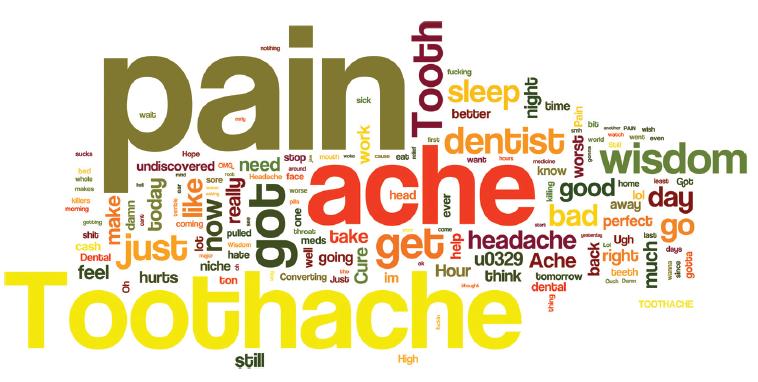 |
| Word cloud created from the tweeted information. The larger the word, the more frequently it appears. From Heaivilin et al: 2011. |
Although such a method of data collection has its limitations, it is important to acknowledge that user generated content of this nature is growing in popularity. If people are sharing such information online and asking for help and advice about dental pain (and one assumes other conditions too) it might be a sign that medical professionals should consider interacting more with the medium. Heaivilin et al acknowledge that as dental professionals, they might "need to act quickly to ensure that [they] are part of the conversation."
As an aside, it has also made me realise that ordinary, every day updates on sites like Twitter and Facebook can be easily used to harvest information like that in the article. I wonder who else is listening to these 'conversations', how they are analysing them and what other articles are being written about them, as we tweet...
References:
N. Heaivilin, B. Gerbert, J. E. Page, J. L. Gibbs. Public Health Surveillance of Dental Pain via Twitter. Journal of Dental Research, 2011; DOI: 10.1177/0022034511415273
Tuesday, 19 July 2011
Happy teeth
Over time teeth tend to wear down. This happens particularly in populations who eat a lot of hard, unprocessed or gritty food. The white of the enamel gives way in little patches to the material beneath it, dentine, which is softer and yellowish in colour. Osteologists can use dental wear to determine the possible age of an individual or the kind of diet they might have had.
However, as I've been looking at teeth, I've discovered something else. At a certain point, the little islands of dentine coalesce and start to look like faces. I shall demonstrate...
Sure, this isn't a finding that will make it into the text of my thesis (unless I'm really, really struggling for word count) but it's something that everyone seems to appreciate. How can you not enjoy looking at teeth all day when they look like this?
However, as I've been looking at teeth, I've discovered something else. At a certain point, the little islands of dentine coalesce and start to look like faces. I shall demonstrate...
 |
| A cheerful 2nd molar... |
Sure, this isn't a finding that will make it into the text of my thesis (unless I'm really, really struggling for word count) but it's something that everyone seems to appreciate. How can you not enjoy looking at teeth all day when they look like this?

 |
| Another cheerful molar... |
Subscribe to:
Posts (Atom)